

BEFORE THE FIRST BREATH -
PRENATAL ASTROLOGY &
HEALING OF
ANCESTRAL
PATTERNS
Complete manuscript · 97,021 words · Seeking a publisher
Before the First Breath: Prenatal Astrology and the Healing of Ancestral Patterns — a 97,021-word work of mind, body and spirit non-fiction that maps prenatal development and ancestral inheritance onto the astrological birth chart.
This book emerges from more than a decade of practice at the intersection of psychological astrology, transgenerational psychology, somatic therapy, and shamanic work. It proposes a framework that does not currently exist in published form: a house-by-house guide to reading the natal chart as a record of who you were before you were born — and what your family was carrying when you arrived.
The book bridges three established but separately published bodies of knowledge: prenatal psychology (Thomas Verny, Gabor Maté, Bruce Lipton), transgenerational therapy (Anne Ancelin-Schützenberger, Bert Hellinger, Nicolas Abraham and Maria Torok), and psychological astrology (Liz Greene, Karen Hamaker-Zondag) into a single, original, astrological grounded framework.
A second book is already in development: a dedicated volume on transgenerational roles as mapped by the natal chart. Seed material has been drafted.
Thank you for your time and consideration.
THE CENTRAL THESIS
The natal chart is not only a map of personality. It is a record of origin.
Every house in the chart corresponds to a developmental stage from the moment of conception through the nine months of gestation to the breath of birth.
By learning to read the chart this way, we gain something extraordinary: we can see, with astrological precision, where our deepest patterns came from. Not to be defined by them but to finally understand them well enough to choose something different.
This is the book's central promise: that by understanding where we came from, we gain the freedom to choose where we are going.

WHAT MAKES THIS BOOK DIFFERENT
A unique book in its field
1
Astrology has many excellent books on signs, planets, and psychological house meanings. Transgenerational therapy has a growing body of literature — led in the English-language market by Mark Wolynn's It Didn't Start with You (Viking, 2016), which has sold over 300,000 copies. Prenatal psychology, established by Thomas Verny in The Secret Life of the Unborn Child (1981), is a recognised field with decades of clinical support.
No published book brings these three fields together in a single integrated framework.
Before the First Breath does exactly that. It proposes that the astrological houses describe not only life domains but developmental stages:
The 8th house → conception
The 9th house → implantation (months 1–2)
The 10th house → skeletal formation (months 2–4)
The 11th house → brain specialisation and social awakening (months 5–7)
The 12th house → final preparation and ancestral absorption (months 7–9)
The 1st house → birth and the gift brought to the family tree
Not only for astrologers
2
This framework has genuine clinical utility. It gives professional astrologers a new lens for reading charts. It gives therapists and counsellors working with prenatal and ancestral material a symbolic map with extraordinary specificity.
And it gives individual readers a coherent, compassionate way of understanding patterns that have, until now, felt inexplicable.
A psycho-genealogical approach
3
The book follows the tradition of serious psychological astrology established by Liz Greene and Brian Clark: intellectually rigorous, psychologically literate, and deeply compassionate. It is not a beginner's guide to the zodiac signs. It assumes a reader who already has a working relationship with astrology and is ready to go significantly deeper.
At the same time it is written for a general reader, not only for professional astrologers. Every astrological concept is explained when introduced. A full glossary is included. The writing balances clinical precision with warmth, and the complex material of prenatal trauma and ancestral inheritance is handled with care throughout.
STRUCTURE AND CONTENT OVERVIEW
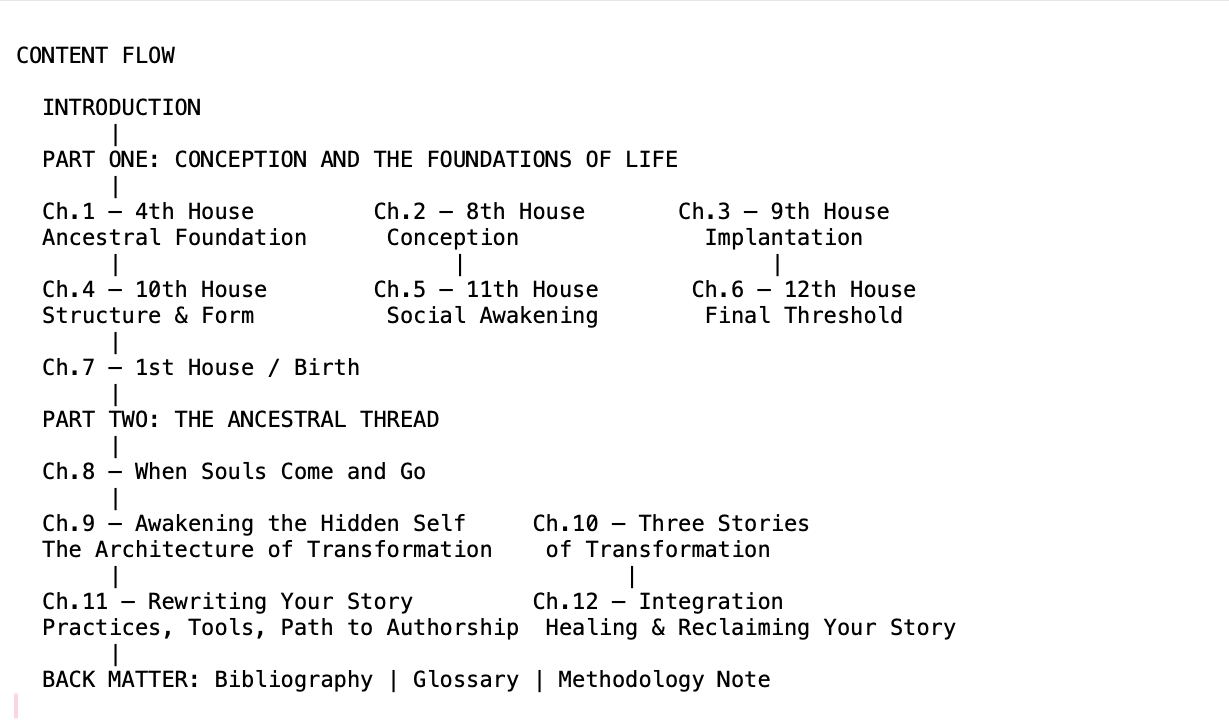
The book follows a chronological and developmental arc:
Part One: From the ancestral foundation through conception, gestation, and birth (Introduction + Chapters 1–7)
Part Two: From birth into the ancestral thread, shadow material, practice, and integration (Chapters 8–12)
This structure mirrors the journey of consciousness itself: from the unconscious (prenatal), through recognition (understanding the pattern), to integration
(conscious choice and healing).
INTRODUCTION
Before the First Breath: Prenatal Astrology and the Healing of Ancestral Patterns Opens with the question at the heart of the book: "Have you ever felt like you were living someone else's story?" Introduces the framework — how the natal chart maps the entire prenatal journey from conception through birth — and explains how this changes everything about what a chart reading can offer. Establishes the scientific grounding (Verny, Maté, Lipton), the therapeutic lineage (Ancelin-Schützenberger, Hellinger), and the astrological tradition (Greene, Hamaker-Zondag) that underpin the work.
Key Themes:
Astrology as a map of origins, not only personality
The fetus as an active participant in its prenatal environment.
Conscious healing as the path from inherited pattern to chosen life.
────────────────────────────────────────────────
Part One — Conception and the foundations of life
One. The 4th House: The Ancestral Foundation. The roots — where you come from
Before conception, there is lineage.
The 4th house is the womb of the chart: home, family of origin, the soil you were planted in before you had any say in the matter. This chapter is about what it means to arrive into a particular family field — the emotional inheritance already in place, the unspoken loyalties, the patterns running long before the child appeared.
Every major planetary placement in the 4th house is covered here, with detailed interpretive entries for the significant aspects each planet makes. It is the longest chapter in Part One and the reader's full introduction to the framework.
Two. Conception and the 8th House: The energetic imprint of your origin
The 8th house is where the soul enter: the domain of conception, transformation, power and the hidden. In this framework it is the most important house in the prenatal map.
Was the conception wanted, or not? An act of love, or of ambivalence? Planned, surprising, celebrated, hidden? The planets in the 8th house and the aspects they make tell that story with unusual specificity. The chapter also takes on the questions raised by assisted reproduction — IVF, surrogacy, donor conception — and what the chart shows about these newer forms of origin.
Three. The 9th House: Implantation and Belonging (Months one and two)
The 9th house is meaning, belief and the search for belonging. At the prenatal level it holds the most primal version of that search: will this life be welcomed? Does the world have room for it?
Discovered with joy, the 9th house imprint carries expansion and faith. Discovered with fear or shame, it carries a foundational doubt — am I supposed to be here? The chapter also traces how inherited belief, religious and cultural, colours the atmosphere of those first weeks.
Four. The 10th House: Building and Structure (Months two to four, when the skeleton forms)
Between the second and fourth months the fetus grows a skeleton. Structure appears where there was none.
That developmental moment maps onto the 10th house: authority, career, public identity, the expectations of the social world. Who holds authority in this family? What is already expected of this child? Is the father present or absent, and what is pressing on the mother in these months? The chapter shows parental expectation and cultural authority entering the psyche during exactly the weeks when physical structure is first laid down.
Five. The 11th House: Belonging and Voice (Months five to seven)
In the middle months the fetal brain specialises rapidly, and the child begins to register the wider social world its mother lives in — her friendships, her community, whether she is held or excluded.
A mother surrounded by community leaves a very different 11th house imprint than one who was isolated or shamed. This chapter follows that imprint forward into a lifelong relationship with belonging, friendship and collective identity.
Six. The 12th House: Before the Threshold
Months seven to nine, final preparation and ancestral residue
The last house before birth: the unconscious, the hidden, dissolution, spiritual service.
Here it maps the final months of gestation: the child fully formed and waiting, the boundary between mother and child at its most dissolved, and the deepest layers of ancestral material absorbed. What the family has never been able to say or mourn arrives in this chapter, and in this house.
One of the most psychologically and spiritually significant chapters in the book.
Seven. The 1st House: Birth and Arrival
The Ascendant is the degree rising at the exact moment of birth — the chart's threshold. This chapter treats birth not as an instant but as a passage: the quality of arrival, the atmosphere of the room, the first breath, the first contact with a world outside the body.
Then it proposes something further. The Ascendant is not only how you appear to others. It is the specific energy you brought into the family tree — the evolutionary impulse contributed at the moment of entering. Where the 4th house describes what you inherited, the Ascendant describes your gift to the lineage.
The longest chapter in the book, covering all major planets on or near the Ascendant, both as records of the birth itself and as descriptions of what was brought.
Part Two — The ancestral thread: past, present, future
Eight. When Souls Come and Go
Abortion, miscarriage, adoption, and the passages between worlds
The most original chapter in the book. It approaches reproductive loss and reproductive choice not through morality or politics but through the chart and through family systems.
These events leave traces in a family field, and those traces surface in the charts of the children born afterwards. The 5th house, the 8th and the 12th all carry the material. The chapter also examines the replacement child — born into a space left by someone else — and the patterns that creates. Handled throughout with clinical care and real respect for how complicated these experiences are.
Nine. Awakening the Hidden Self
Reclaiming agency from conception to consciousness
The pivot. Having mapped the prenatal and ancestral field, the reader is finally asked: what do I actually do with this?The chapter introduces the architecture of awakening — recognising the inherited pattern, tracing its origin, witnessing what was, and choosing what will be. It answers directly the fear that understanding your origins means being defined by them, and offers instead the chart as a map held lightly: an instrument of freedom rather than fate.
Ten. Three Stories of Transformation
Three extended case studies carrying the whole framework from chart to outcome.
Eleven. Rewriting Your Story
Practices, tools, and the path to authorship The practical core of the book. A five-step method for working with prenatal and ancestral material — Witness, Trace, Feel, Differentiate, Choose — each step explained in depth and applied to chart placements, body sensations and relational patterns.
Twelve. Integration
Healing the gestational houses and reclaiming your birth story
How do you live differently, over time, once you have seen what the chart shows?
MARKET AND AUDIENCE
The book sits at the intersection of three commercially established markets:
1. SERIOUS ASTROLOGY
The global astrology market has expanded dramatically since 2015. Co-Star has over 20 million users. Demand for serious, book-length astrological education is at an all-time high.
2. TRANSGENERATIONAL AND ANCESTRAL HEALING
Mark Wolynn's It Didn't Start with You (Viking, 2016) sold over 300,000 copies. Daniel Foor's Ancestral Medicine (Inner Traditions, 2017) is widely used in therapeutic and spiritual communities. The appetite for books on what we inherited — and how to heal it — is large and growing.
3. PRENATAL AND PERINATAL PSYCHOLOGY
Thomas Verny's The Secret Life of the Unborn Child (1981) has been in print for over forty years. Gabor Maté's work on early imprinting is read across therapy, parenting, and healing communities. This audience is looking for new frameworks.
This book speaks to all three simultaneously, offering something no existing title provides: a single integrated framework tying all three together through the language of the natal chart.
TARGET READER
— Intermediate to advanced astrology students and self-taught practitioners
— Professional astrologers expanding into ancestral and prenatal work
— Therapists and counsellors interested in astrological tools
— Anyone in deep personal healing, shadow work, or family-of-origin exploration
— Individuals working with family constellation therapy (Hellinger method)
— Pregnant women or those planning pregnancy
— Readers of Liz Greene, Steven Forrest, or Brian Clark seeking the next level
ABOUT THE AUTHOR:
GIORGIA
PECORA

Giorgia Pecora is a psychological astrologer, teacher, and ancestral healing practitioner whose work synthesises astrology with transgenerational psychology, somatic therapy, and shamanic practice. Specialising in karmic astrology, prenatal imprinting, and the mapping of family patterns through the natal chart, she has developed an integrative approach that traces emotional inheritance across generations with both astrological and psychogenealogical precision.
Giorgia holds an MA in Astrogenealogy from Escuela Astroconstelaciones and is certified in Psychogenealogy through the International School of Psychogenealogy — credentials that place her among the few practitioners worldwide trained to work at the intersection of astrological interpretation and transgenerational psychology. She holds further certifications in Modern Astrology through the Centre for Psychological Astrology (CPA London / Mayo School) and is an accredited Sexological Bodyworker through The Sea School of Embodiment. Her shamanic training spans over a decade. She also holds an MA in International Relationships and Intercultural Learning.
Since establishing her practice in 2016, she has worked with clients from all over the world and with thousands of students through workshops, online courses, and residential retreats combining astrological education with embodied practice.
She has lectured at the Astrological Association of Great Britain, Kepler College, the Kairos School of Astrology, the Australian Astrological Collective, the Brighton and Hove Astrology Circle, and Astrology Severn. She is a member of the Organization of Professional Astrologers (OPA) and the JWG Association of Evolutionary Astrologers.
She is the founder of Visionary Astrology, a school and private practice based between Spain and Portugal. Before the First Breath is her first book.
visionaryastrology.org | @visionaryastrology